Lighting
Choose bedside lighting from the position where you read
Test the beam, shade, switch, and mounting position from bed before buying a pair of lamps or committing to wall lights.
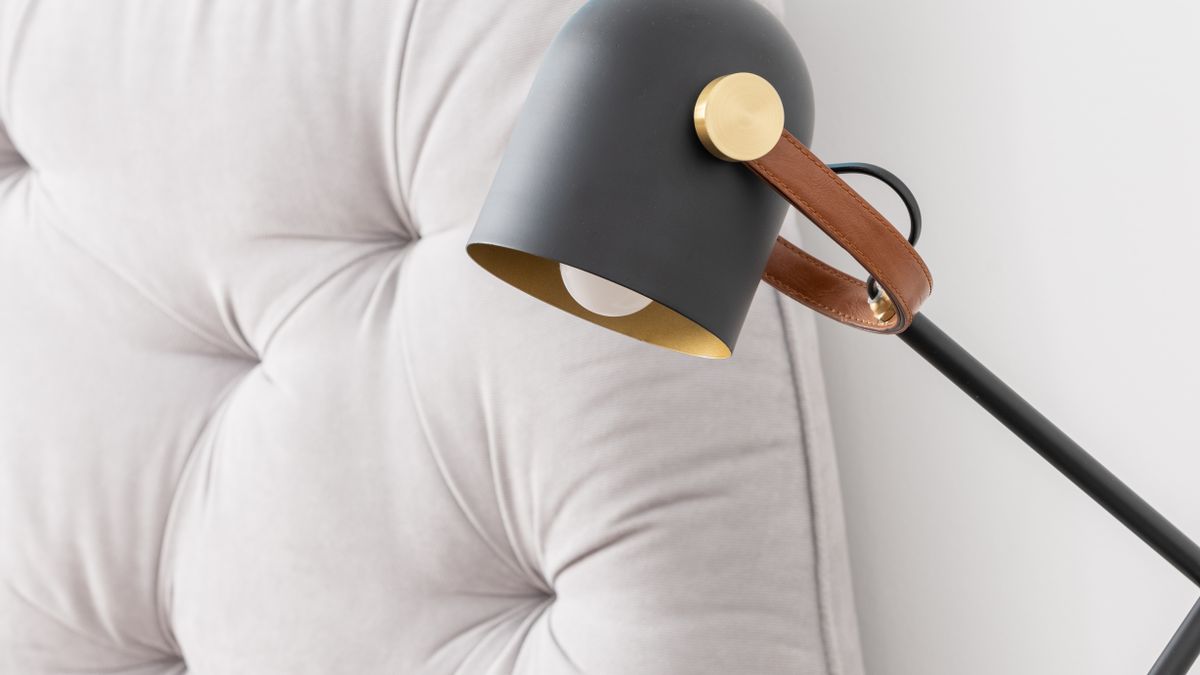
The bedside light that looks right at the foot of the bed can be wrong from the pillow. A shade may hide the bulb from the standing visitor and expose it at exactly the height where a reader puts their head. A wall lamp may clear the nightstand beautifully until someone has to sit up to reach its switch. Test bedside lighting in the position in which each person will use it. Look for light on a page or object, a control within comfortable reach, and a beam that stays mostly on the side where it is needed.
Settle the bed before settling the lamp
Mattress depth gives you a better starting point than floor height alone. The goal is to know where your shoulders, eyes, and hands are once pillows are in place. Put your normal stack of pillows against the headboard and sit back with the book, newspaper, or device you actually read. If you tend to turn on your side before switching the light off, try that position too. Have the other occupant make the same test on their side. Two people may end up with noticeably different comfortable reach and reading angle on the same mattress.
Measure from the edge and top of the mattress to the places you can reach easily without twisting. Then measure where a shade or fixture would be relative to your eyes. The top surface of a bedside table might sit above the mattress or well below it. Those dimensions will make the very same lamp behave differently. If a new mattress or a higher base is planned, use the planned height during the test. Choosing a wall fixing around the old arrangement can produce a difficult surprise on delivery day.
The headboard matters too. A thick upholstered board may push the pillows away from the wall far enough that a wall lamp's arm needs additional reach. An angled headboard can do the opposite, leaving a bright fixture closer to a face than the side elevation suggested. Make a mock-up with paper taped to an appropriate surface or with a cardboard cutout propped behind the bed. Mark the shape of a fully extended arm as well as the fixture at rest. It should clear the pillows, window trim, and tall wardrobe door when moved.
Aim for the page and look back at the source
Start with a temporary lamp to establish a good direction. Move the light toward the side and slightly behind your shoulder if the arrangement allows it, then check the shadows produced by your head or hand. A left-handed person writing in a notebook may want a source from the opposite side of someone who writes with the right hand. What matters is the shadow on the task, not symmetry across the furniture. Try a book with pale pages and another with darker print or glossy illustrations. Reading in the room tells you whether an attractive low light is enough for the job.
Look directly along the normal line of sight with the lamp on. Check how much of the bright light source you can see. A long shade can cut off the glare while allowing a broad wash, while an opaque housing on a narrow beam can keep light only where it is wanted. A semi-transparent shade produces a soft illuminated object as well as directional task light. That can be pleasant in an evening room, but it may be much too bright for a partner who is trying to sleep. Test whether a bright lamp reflects in a mirror across from the bed. The mirror may send light to the other side even when the beam is well aimed.
Try a few minutes in the room after the brighter overhead fixture is off. The bedside light may feel different once your eyes are accustomed to it. Mark whether a little additional background illumination is useful. A lamp with a broad lower opening may serve both reading and general soft light, whereas a small spot might make the page rather bright compared with the rest of the room. Someone who reads for half an hour may prefer an easy adjustment at the head of the bed. The person who mostly needs to find a glass at night may want a lower lamp or a separate dim setting.
Leave a reliable way to turn it off
With your hand where it rests before sleep, reach for the proposed switch location. A switch on the cable often looks simple in a product listing. It is less simple if the cable drops down behind the table and the switch stops lower than your extended arm can reach. A switch on the base can be hard to reach if the lamp has to sit at the far end of a deep table. A small switch on the shade arm may be ideal at first and become awkward if the arm is moved. If buying in person, operate the control with a hand in the same position you will use in the bedroom. Consider ease of grip, visibility in darkness, and whether the switch clicks too loudly to be pleasant.
An entry switch is useful even when the lamps have individual controls. It can give a visitor an obvious way to illuminate a room before searching for the bedside lights. If outlets are switched, ask which socket remains powered and what happens when somebody turns off the wall control. Before purchasing dimmable lights, confirm that controls, bulbs, and drivers are compatible. Check what happens at the lowest setting and after the fixture is turned back on. A lamp that jumps to full brightness before dimming may make an otherwise suitable design uncomfortable at night.
Consider power failure or a disconnected device if the fixture requires an app or remote. The simplest test is to hand someone the room without instructions and watch how easily they find the light. A control that depends on a phone can be inconvenient in a guest room or when a charging cable has gone missing. A well-positioned manual switch gives the room an ordinary mode of use even if more involved controls are available. For households with different sleep schedules, check whether both sides can be used independently without interfering with the lights needed to travel between the bed and the door.
Compare the table, the wall, and the headboard
A table lamp has the advantage of leaving with you and moving when the room changes. Set the actual footprint on the bedside surface, including any base projection and cable. Leave room for the other things stored there. A lamp that shares a small table with a water glass needs a stable base and an arrangement that keeps liquids away from electrical equipment. If you use a particularly small surface, a wall lamp or suitably designed clip-on fixture can open up space. Check what the clip is made for and whether the surface is stable enough for it, especially if the arm will be moved on a routine basis.
A wall fixture can put its shade in an excellent position. It also ties the position of the bed to work on the wall. If the arrangement may shift sideways after flooring or wardrobe changes, test whether an adjustable arm can accommodate that. For a plug-in fixture, plan its cord route without pinching or covering the cord, crossing a walkway, or creating a hazard near the bed. A hardwired design calls for the appropriate electrical work and qualified installer. Ask about a paired drawing with the location of framing, controls, and power before the wall is opened. Confirm the position with the assembled bed or an accurate model of its outline.
Left and right fixtures need not be identical in output or type. A visible pair of shades may produce a calm arrangement when the fixtures are used in broadly similar ways. In a room where only one person reads, a diffuse lamp on one side and a shaded adjustable reader on the other can give the people better conditions. Check the overall arrangement from the door after testing use from bed. A similar shade shape, a shared finish, or a consistent bulb tone may be enough to make the choices belong together.
Make the trial last past one good evening
Try your preferred approach on two nights, including one when the person who goes to bed earlier is already settled. Notice whether light leaks into the adjoining hall or comes through the gap below a door in a way that matters to the household. Lay the book down and reach for the switch without getting up. If bright illumination is useful while dressing, check where that light comes from so the reader doesn't have to do everything. Keep enough general light available to navigate the room safely. The reading fixture can then be chosen on its own merits.
Write down the final shade position, switch height or reach, and mount or table dimensions. Keep the lamp model and compatible bulb details if they are easy to lose. A few measurements from a real evening can save you from choosing a light twice. If your strongest observation after several uses is that the switch was always where you expected and the page was clear, the choice will probably feel right for much longer than the first photograph.