Materials
What a wallpaper sample cannot show by itself
Check scale, repeat, lighting, seams, and substrate with a physical mock-up before committing to wallpaper for an entire room.
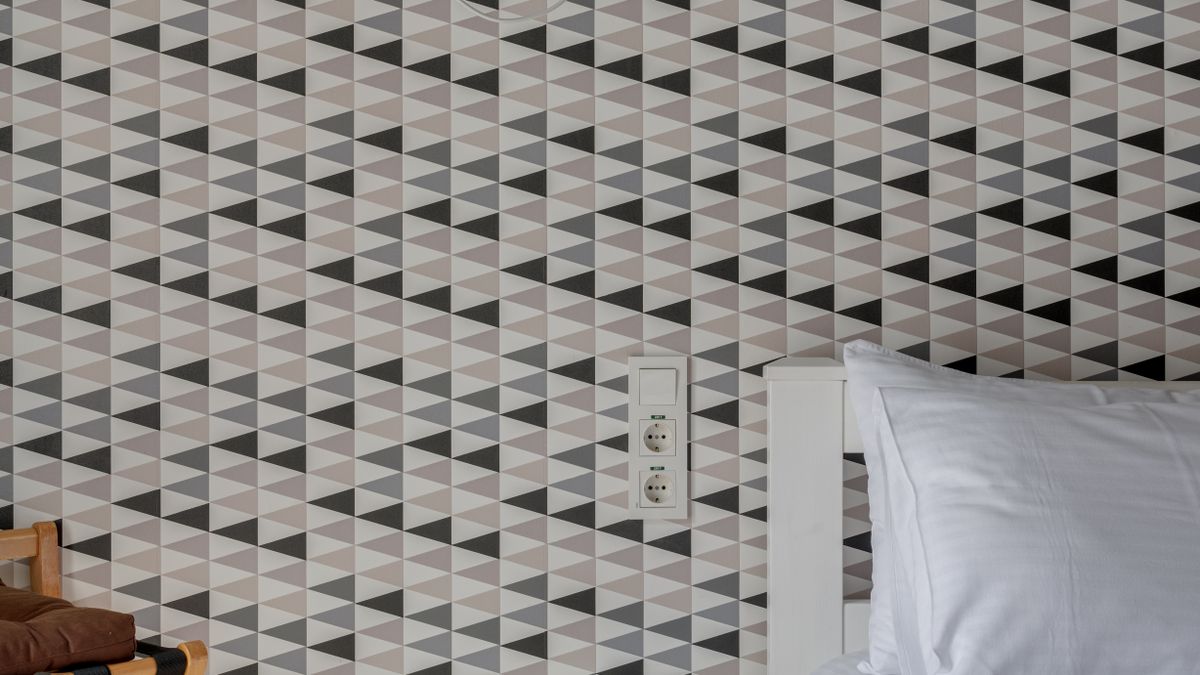
The little wallpaper cutting is usually the most flattering version of the design. All the important shapes fit inside it, the paper is flat, and there is no door, switch plate, or inside corner to interrupt the view. On a wall, the same design becomes a field of repeating intervals. A straight stem meets the edge of a window casing. What looked like a soft background may show up as a strong horizontal rhythm when the sofa sits beneath it. The first thing to learn from a sample is whether you like the material. The more expensive question is whether you want its repeat, seams, and finish in that particular room.
Find the size of the thing you fell for
Put the sample next to a tape measure and inspect the manufacturer's dimensions. Record the usable width, the vertical repeat if one exists, and the match type. A straight match lines neighboring drops up at the same height. An offset match moves the next drop vertically by the specified amount. A free match allows drops to start without aligning a motif, although the specific manufacturer may still call for attention to orientation or shading. A one-off mural is a different purchase. It may have numbered panels that must be installed in sequence with extra allowance at the outside edges.
The sample may contain less than one complete repeat. Ask for a larger cutting or download the full pattern diagram and look at the dimensions written next to it. A sample showing two leaves will not tell you how often the large branch turns up. Printed product images can be helpful for understanding placement, so long as you treat their color and scale as approximate. If the seller shows the pattern in several room settings, use an actual item like a known door height only as a rough visual reference and confirm the repeat from the specification.
A low-tech way to make the interval visible is to trace a few important shapes in outline on kraft paper. Use the listed width and repeat to sketch two or three neighboring drops at full size. The drawings need only show where the large shape appears and where it is absent. Tape the sketch at the likely starting height and stand across the room. Step into the doorway from the hall and look at it there too. Looking from the entrance often reveals the diagonal or stacked effect you miss when testing from arm's length.
Give interruptions as much attention as the pattern
Decide where a central shape ought to land. Over a bed, a centered motif can work if it survives the headboard. Beside a tall window, the same choice may leave only a sliver of the next repeat in view. Mark the center of the longest clear wall, then mark the center of the object that will actually anchor that wall. If they're a few inches apart, try both reference points. The better view may depend on which edge people notice first. A narrow powder room with an off-center mirror could look calmer if the paper pattern follows the mirror and spreads out to either side.
The two hardest edges are often a wall return and the strip above an opening. A wall can be plumb enough for paint yet look out of line when a repeating stripe approaches the corner. Ask your installer how they plan to handle corners, casing, headers, and the last seam. The room's most prominent wall deserves the cleanest alignment. It may be sensible to let a less visible area absorb the unavoidable discontinuity instead. A full-height unbroken motif beside one corner should count as a decision, because shifting it later changes the start point for the whole room.
An ordinary switch plate interrupts a pattern at hand height. Lay the cutting against the wall with the edge of the plate in view. Check it once with your actual cover plate and once with a plain alternative only if you are willing to replace the plate. Making the plate disappear against a busy design is difficult. An edge that looks tidy and readable is often a stronger outcome. Have any work involving the wiring or electrical device handled as appropriate. An existing plate can be represented accurately enough with a cardboard outline while planning.
Look for sheen and joins after dark
Take the sample into daylight and then into the artificial light that the room actually receives. Angle it gradually in front of a wall lit from the side. A metallic ink may briefly brighten much more than expected. A textured face can darken when its little shadows point toward the lamp. A very smooth coating may show reflections from a nearby fixture, which could bother you if it sits behind a reading chair. Make a note of which combinations work from the usual place you sit. Walking around with the sample is useful. Judging the finished result from sitting height is better.
If the vendor can provide two cuttings of the same design, place their edges together at the pattern match. This is a good time to ask whether the paper is pretrimmed and how seams are normally made for that product. The look of a taped sample seam is only an approximation, yet it may expose a strong light edge or a particularly difficult transition. Textured materials and natural fibers can show more noticeable panel-to-panel differences. Ask about that before expecting the appearance of a solid painted wall. Adjacent rolls from the same run are still worth comparing once they arrive, before any have been cut.
Color estimates drawn from retail photography can fail badly. A background that looks white online can feel putty-colored in a room with cool daylight. Set the sample alongside the trim, curtains, tile, or flooring after the paper has had time to flatten. Focus on one pair of materials at a time. With the whole scheme piled on a table, you can end up liking an arrangement that will be several feet apart once installed. If the wallpaper will stay for years, give permanent materials more weight than bedding that can easily be swapped.
Calculate by usable drops
A room with ample total roll area can still be short of a drop. Measure each wall height, note the tallest point, add the trimming allowance recommended by the installer, and use the product's repeat to estimate the length required for each complete drop. For example, a proposed cut length of 8 feet 4 inches may use a greater interval once the pattern has to line up with the next piece. The outcome depends on the precise match, the starting motif, and what remains at the end of the roll. Openings sometimes permit useful offcuts. They cannot always be subtracted like empty rectangles if the pattern has to run across their tops.
Roll, double roll, and bolt terminology can vary by shop. Ask what the listed price actually buys in physical length and useable width. Let the installer check quantities and decide how much extra is sensible for awkward matches, existing conditions, and future repairs. Compare that order with the return rules for unopened rolls and with the availability of the same batch. If you need to replace a damaged panel later, a leftover remnant may be more useful than a new roll with a different color lot. Store a small labeled record of the item number and lot with the spare material.
Ask the wall a practical question
Check whether the wall is smooth, stable, clean, and dry, and whether the product is appropriate for the conditions in that room. Crumbling plaster and persistent moisture need the underlying problem addressed before any decorative covering goes up. Adhesive, primer, liner, wall preparation, and removal method depend on the type of wallcovering and substrate. Review the installation instructions before choosing a paper solely because its front looks appealing. A product sold as removable can still be difficult to take down from the wrong surface. In a rental, confirm the permission and removal requirements in writing and try the approved product on an inconspicuous area.
Ask who will prepare the wall and what that work includes. If you are comparing quotes, a low price that excludes filling, sanding, lining, priming, disposal, or tricky corners can be hard to compare with a complete installation. If you want the color at a cut edge to be inconspicuous, ask how the installer deals with it for this specific paper. Bring the product information and the marked-up sketch to the conversation. Joint decisions become easier when everyone is talking about the same width, finish, and pattern.
If the roll shows a pattern that is pleasant in principle but overbearing at an internal corner, see if you can place the material on a shorter wall that catches the first view into the room. Test the end on an actual width of wallpaper or a paper mock-up. That position preserves the impact of the pattern without asking it to continue through the point where it was hardest to resolve.
The last test is to stand at the place you tend to notice the room from. It might be the hall or the side of the bed where you sit to put on shoes. Look at the rough mock-up and then put a hand over the part that bothers you. If the whole pattern becomes calmer when you cover one inconvenient branch or line, see if changing its placement fixes the room. If the rhythm bothers you everywhere, try another paper. That decision is wonderfully cheap while the room is still held together with tape.